Time Slot Management Explained
Time slot management is the process of assigning trucks fixed arrival windows at a warehouse or distribution center, instead of letting them arrive whenever they want. Carriers book a slot in advance based on real dock capacity, which spreads arrivals evenly across the day and prevents the gate queues, idle labor, and detention fees that come from uncontrolled peaks.
If your warehouse handles dozens (or hundreds) of trucks a day, you've probably already seen the problem this solves: too many trucks show up at once, docks get congested, drivers wait, and operations fall behind. This guide covers how time slot management actually works in practice — not just the definition — plus a real example, the mistakes that sink most implementations, and when it's actually worth setting up.
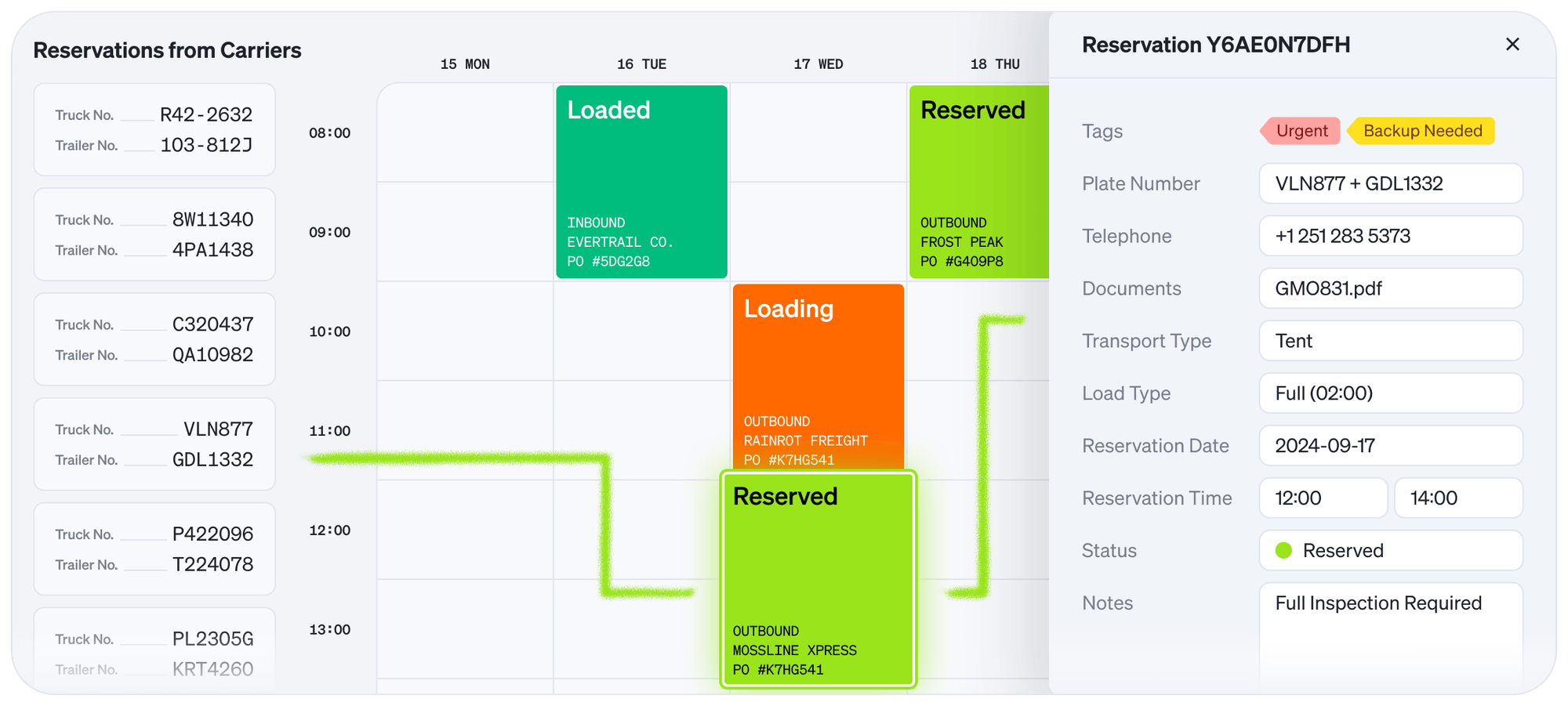
How Does Time Slot Management Work?
Time slot management isn't just a booking calendar — it's a workflow that coordinates carrier arrivals and warehouse capacity in real time. It runs in five stages:
1. Defining warehouse capacity
Everything starts with understanding what the warehouse can realistically handle: number of available docks, average load/unload time per truck, operating hours and shift patterns, and priority rules (e.g., urgent or temperature-sensitive shipments). These constraints set the ceiling on how many trucks can be processed in any given hour.
2. Carriers book time slots
Carriers select from predefined windows through a scheduling platform — based on availability, load type, and operational constraints — rather than calling or emailing to arrange a time.
3. Allocating and balancing demand
As bookings come in, the system distributes them evenly instead of letting trucks cluster at peak hours. It prevents overbooking and applies business rules automatically — this is what stops congestion before it starts.
4. Adjusting in real time
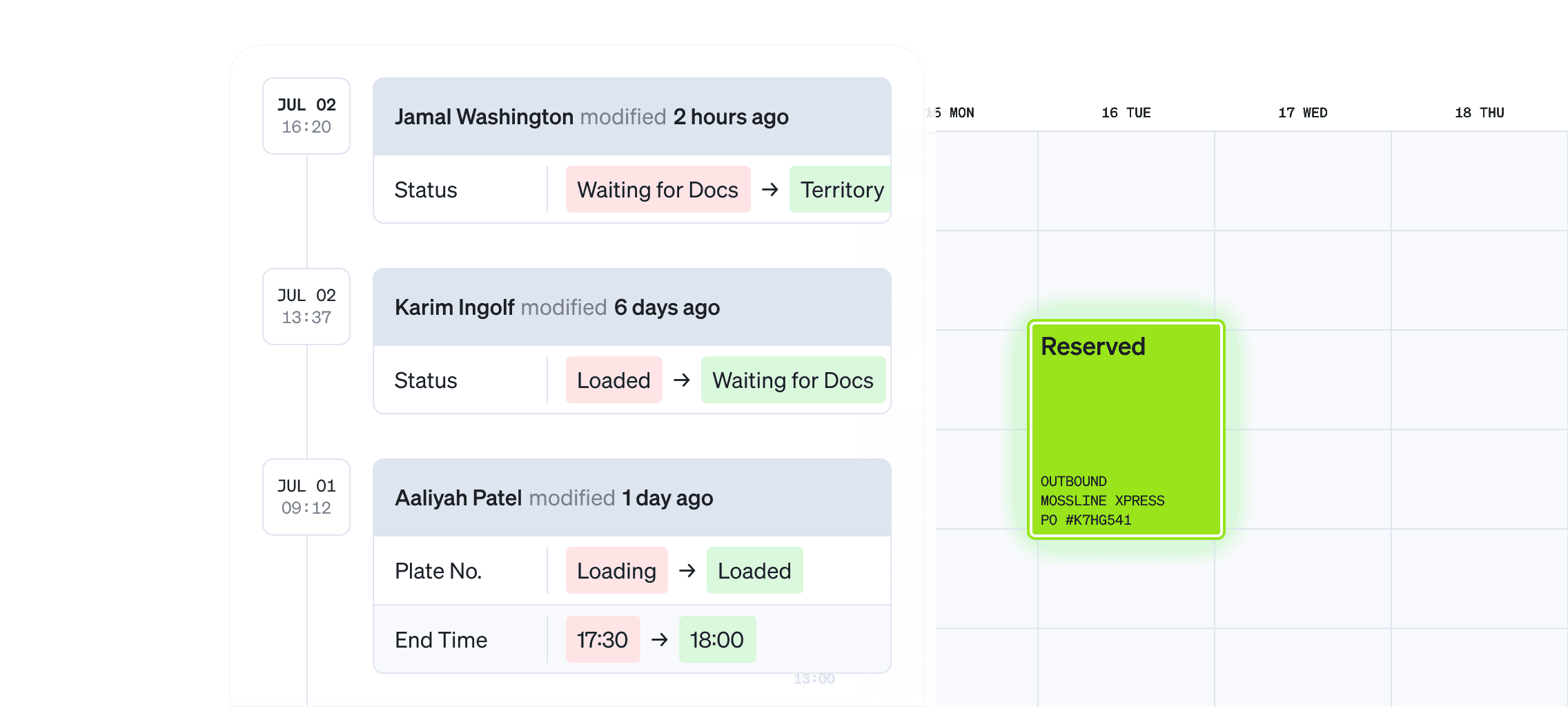
Trucks arrive early or late. Delays happen. A good system lets teams reschedule dynamically and track it on live alerts and dashboards, instead of working off a static plan that's already wrong by 9 a.m.
5. Executing on-site
With arrivals controlled, docks get assigned more efficiently and loading/unloading follows a smoother flow — this is where the plan turns into an actual operational improvement.
Quick example: A warehouse with 10 docks, each handling 2 trucks/hour, can support 20 bookings/hour spread evenly across the day — instead of 40 trucks all trying to arrive at 8 a.m.
Manual Scheduling vs. Time Slot Management Software
Curious what this would save your operation specifically? Run the numbers with Goramp's ROI calculator.
Real Warehouse Example
A distribution center handling around 120 trucks a day across 8 docks was experiencing heavy morning congestion. Nearly 40% of trucks arrived between 8 and 10 a.m., pushing average wait times to 90 minutes — all managed manually through emails and spreadsheets.
After implementing time slot management, carriers booked predefined windows and arrivals spread evenly across the day. Waiting times dropped significantly, dock utilization became consistent, and warehouse teams could plan labor around expected arrivals instead of reacting to them. The biggest change wasn't efficiency on paper — it was regaining control over daily operations.
Benefits of Time Slot Management
- Reduced waiting times: fewer trucks arrive at once, so queues shrink and turnaround speeds up
- Higher dock utilization: docks run at a consistent pace instead of peaks and gaps
- Lower detention and demurrage costs: better scheduling means fewer delays and penalties
- More accurate labor planning: teams staff around expected arrivals, not guesswork
- Better carrier experience: less time waiting means higher compliance and satisfaction
Peikko Romania achieved 60% time savings in transport coordination, with fewer emails, fewer calls, and better real-time visibility.
Other documented results: an FMCG company managed the same monthly truck volume with 20% less workforce by distributing arrivals evenly; a steel supplier cut detention fees by 90% through improved visibility and coordinated scheduling; multiple operations achieved €500,000+ in combined savings through workforce efficiency and reduced detention.
When Do You Need Time Slot Management?
You likely need it if: you handle 50+ trucks a day, you're dealing with dock congestion, scheduling is still manual or fragmented, carriers frequently arrive early or late with no visibility into why, or your team spends more time coordinating schedules than executing operations.
Before a system is in place, this usually looks like a "Wild West" pattern: multiple trucks clustering at the same hour, dead time the rest of the day, and no coordination between carrier ETAs and warehouse capacity. The cost isn't just operational — it shows up as overtime, detention fees, and warehouses effectively paying twice: once for their own inefficiency, and again for the delays it causes carriers.

4 Mistakes to Avoid When Implementing Time Slot Management
Treating it as a rigid control system
Logistics is unpredictable — traffic, weather, and operational issues happen. A system that punishes every small delay pushes teams back to manual workarounds and makes carriers see the tool as a barrier, not a help. Balance structure with flexibility.
No real-time visibility
A static schedule looks fine on paper and is outdated within hours. Without a live view into arrivals and dock availability, the system becomes a constraint instead of a support tool.
Poor system integration
If time slot management isn't connected to your warehouse management or TMS, teams end up manually cross-checking data and falling back on spreadsheets anyway — which erases most of the efficiency gain. (Not sure which WMS fits your setup? Here's how to choose one.)

No clear ownership or carrier adoption
Without a defined owner, rollout stalls and responsibilities blur. And if booking a slot is complicated for carriers, they'll revert to calling, emailing, or just showing up whenever. Successful rollouts focus on making participation easy, not on enforcement — this is a common theme in the problems time slot management is meant to solve in the first place.
What Changes After Implementation
For carriers and drivers, the biggest shift is predictability — no more guessing whether a stop will take 30 minutes or five hours, which means less wasted fuel and better route planning.
For warehouse operations, teams stop reacting to congestion and start processing orders on a consistent, predictable rhythm — turning a high-pressure environment into a structured one with clear expectations for what happens and when.
FAQ
What is the difference between dock scheduling and time slot management?
They're largely the same concept — dock scheduling is the broader operational activity, and time slot management is the method used to do it, by assigning trucks fixed arrival windows instead of first-come, first-served access.
How many trucks per day justify a time slot management system?
Most warehouses see clear ROI once they're handling 50 or more trucks a day, or whenever manual scheduling starts causing regular congestion or missed coordination.
Does time slot management work with existing WMS or TMS systems?
Yes — modern time slot management software integrates with warehouse (WMS) and transportation (TMS) management systems so bookings, capacity, and real-time changes stay in sync.
What happens if a truck arrives outside its booked slot?
This depends on configuration. The most successful setups build in flexibility for real-world delays rather than rigidly penalizing every late arrival, which keeps carriers using the system instead of reverting to manual coordination.
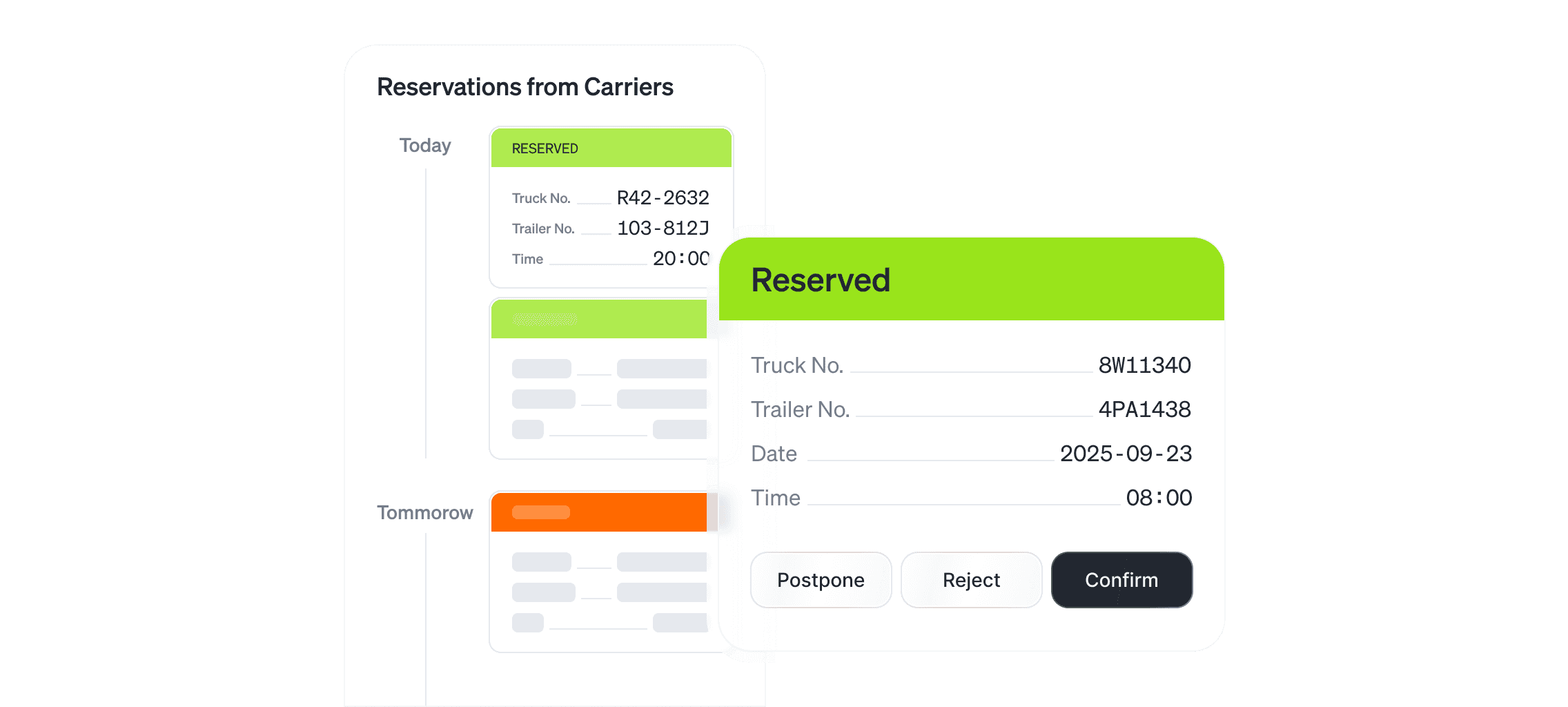
Improve Your Dock and Yard Management with Goramp
Goramp's time slot management solution integrates directly with your warehouse management and yard management systems, giving you real-time transparency across the full flow — not just booking, but arrival planning through yard execution.
With Goramp, teams can manage time slot bookings against real, live capacity, adjust schedules dynamically when delays happen, and coordinate yard and dock operations from one system.
Time slot management isn't just a scheduling tool — it's how you bring structure, predictability, and control to warehouse operations.


